How to fight the flab and other tips for a healthier workplace
Every design decision we make will have an impact on employee health. A neuroscientist advises on environmental ways to reduce stress, encourage healthier eating and manage waistlines
More and more designers and the organisations that employ them seem interested in creating workplaces that elevate physical health. All of this attention seems particularly apropos right now in the northern hemisphere as the season change makes exercising outdoors less pleasant.
Current health-related efforts have moved beyond considerations of materials that won’t physically poison people in the work environment to supplying humans with the tools they need to live healthier lives. All the options noted below for increasing wellness, reducing stress and managing weight are supported by neuroscience research.
Cutting stressors
Stress-inducing distractors are being eliminated from workplaces whenever possible—which has obviously good consequences for the ability of workers to concentrate, and less observable but equally positive and powerful effects on the functioning of immune systems.
Cutting stressors makes it much more likely that we’re in a good mood. As Sternberg (2009) relates, ‘The brain . . . sends its own signals to immune cells – hormones and nerve chemicals that can tune up or tune down the ability of immune cells to fight disease. There are many things that can influence the release of these chemical signals from the brain, and our surroundings play a very important part.’
Lamb and Kwok (2016) carefully quantify the effect that removing stressors has on performance and report results indicating that environmental stress reduces not only the cognitive capacity for work, but also the rate of work (i.e. by reducing motivation). They report that ‘increasing the number of individual stress factors is associated with a near linear reduction in work performance indicating that environmental stress factors are additive.’
Neuroscience research has also shown that it is perceptions of stressors that drive their negative effects on health and not absolute measures of them; if people perceive conditions as negative, repercussions for health are similarly adverse.
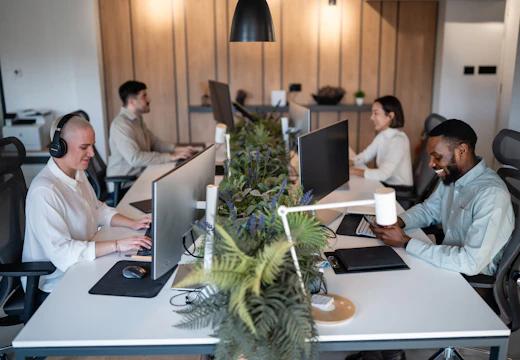
Views of green leafy plants and hearing natural soundscapes can support recovery from stressful events that inevitably occur as people work together; the presence of both plants and nature sounds have also been shown to improve performance.
Healthy eating
Healthy eating also gives a boost, with efforts to do so no longer focus on making healthier options more prominent in displays than less healthy ones. Increased use of art featuring pleasant nature scenes and, separately, broadcasting nature soundtracks in areas where food selections are being made makes healthier choices more likely.
As in-space clutter falls, likelihood of healthier food choices increase. Seeing yourself in a mirror as you eat has also been tied to consuming food that is better for you.
Even the sorts of seats available influence what food is consumed. As Biswas et al. (2019) report, sensations related to posture influence perceptions of how food tastes. Standing postures induce greater physical stress on the body than sitting, which in turn decreases sensory sensitivity. As a result, when eating in a standing posture, consumers rate the taste of pleasant-tasting foods and beverages as less favourable – and they consumer smaller amounts.
Managing your weight
Lighting and window treatments that support keeping circadian systems aligned with the time of day keep weight gains in check and space users healthier. Making stairwells more pleasant places to be (by adding art to them, for example), increases the likelihood that they’ll be used instead of elevators, which is good for waistlines, cognitive performance, and the planet.
Locating stairwells so they are more likely to be seen than elevators and incorporating internal staircases between floors rented by the same firm also increase traffic on stairs.
Green views and slightly brighter than usual lighting also encourage healthier choices in general and have been tied to some very desirable outcomes, such as reduced cravings for cigarettes and more frequently taking advantage of opportunities to exercise. Finally, providing options for people to stroll at their own pace during work time can help improve cognition and creativity while burning off calories.
Research sources
Dipayan Biswas, Courtney Szocs, and Annika Abell. 2019. ‘Extending the Boundaries of Sensory Marketing and Examining the Sixth Sensory System: Effects of Vestibular Sensations for Sitting Versus Standing Postures on Food Taste Perception.’ Journal of Consumer Research, vol. 46, no. 4, pp. 708-724.
- Lamb and K. Kwok. 2016. ‘A Longitudinal Investigation of Work Environment Stressors on the Performance and Wellbeing of Office Workers.’ Applied Ergonomics, vol. 52, pp. 104-111.
Esther Sternberg. 2009. Healing Spaces: The Science of Place and Well-Being. Harvard University Press: Cambridge, MA.