Practical value: turning AI potential into scalable solutions
Modern buildings generate vast amounts of data, but the systems that manage them often operate in isolation. Coor and WORKTECH Academy's latest report explores how AI is delivering consistency into a fragmented FM landscape
Today’s buildings generate more data than ever, yet for the people that run them, translating the data into practical insights is still a challenge. Data is collect through different streams which often remain separate and disconnected, and it is usually the job of FM teams to stitch together insights across a portfolio of buildings. However, AI is beginning to bridge that gap; creating practical value in the data held by workplaces, buildings, services and operations.
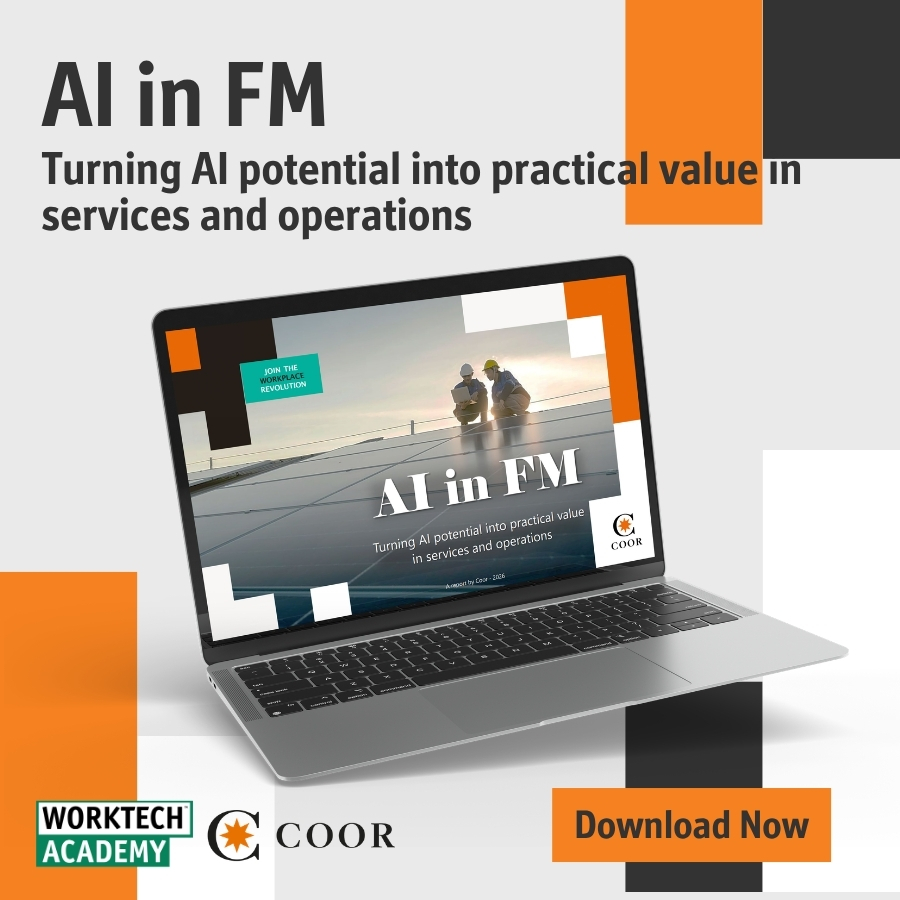
This evolution is highlighted in a new report by WORKTECH Academy in partnership with Coor, titled ‘AI in FM: Turning AI potential into practical value in services and operations.’
The report highlights two key opportunities: the ability for AI to make better use of the data available across and around buildings; and to reduce the friction throughout the workplace. Highlighting not only how AI can support people in daily tasks, but also how it can structure information and help coordinate consistent workflows, allowing teams to manage operational complexity with less effort and quicker responsiveness.
The sentiment was reiterated across a Nordic survey of approximately 500 FM decision-makers, 43% believed AI will significantly change how workplaces are planned, managed and delivered. And a further 45% reported that they’re either piloting or utilising more advanced autonomous AI solutions or AI agents within their operations.
A framework for AI adoption
The report identifies three pillars for AI adoption in facilities management.
Assistance AI functionsd primarily as a service layer, enabling users to access information, guidance and support more efficiently. It simplifies navigation across a range of organisational resources, from identifying suitable workspaces and services to responding to requests and locating relevant documentation. By reducing the time and effort required to search for, interpret and document information, it helps streamline everyday processes and improve access to the knowledge and services users needed.
Analytical AI supports a shift from reactive management towards more informed, evidence-based decision-making. By analysing data across areas including occupancy, user feedback and supplier performance, it identifies patterns, highlighting emerging issues and providing greater visibility of operational performance. This enables organisations to make more informed decisions about maintenance, resource allocation and service provision, while supporting the identification of risks, changing user needs and opportunities for improvement across the wider portfolio.
Agentic AI builds on analytical insight by connecting intelligence with execution. It supports the coordination of actions across workplace, facilities, security and commercial processes, including routing requests to the appropriate owner, initiating routine service actions, preparing tasks and work orders, managing stock replenishment, and supporting prioritisation and escalation. By interpreting information and coordinating next steps, agentic AI assists organisations in moving towards more efficient and consistent execution.
The Nordic landscape
The current AI agenda is strongly efficiency-led, with reducing manual work and improving speed as the highest cited objectives. High-ambition organisations place weight on productivity but are likely to add broader objectives to their remit; such as more capable decision-making and advanced cases for operational use.
A distinction arises between visible AI and operational AI, with some of the most valuable applications not always being obviously visible to end-users. Currently, employees primarily associate AI with saving time (55%), making work easier (41%) and reducing repetitive tasks (33%). Employees also judge AI less by its technical sophistication and more by whether it improves everyday work and service interactions.
In contrast, the top concern around AI was risk of errors or incorrect decisions (42%), followed by data privacy/security (28%) and poor-quality or unreliable tools (24%). While the potential impact on job security wasn’t absent, it ranked lower at only 19%. Together, the picture suggests that there isn’t an abstract resistance to AI itself, but more concern about trust, reliability and transparency.
Connecting intelligence, insight and execution
Facilities management has a central role to play in the transition and adoption of AI in the workplace. Few functions sit closer to the practical environments in which AI can deliver actual value, giving FM teams a uniquely strong foundation from which to translate potential into practical outcome. As AI develops past simply providing assistance and turns toward supporting insightful execution, FM will be perfectly positioned to shape how these capabilities are applied across the workplace.
Read the full report, ‘AI in FM: Turning AI potential into practical value in services and operations’, here.