Open minds: why curiosity should be designed into workspace
Two new research studies have reinforced what neuroscientists have known for a long time: curiosity is good for the brain and should be a key component of workplace performance
Curiosity is a wonderful thing. When we’re curious our minds open up and we ponder what has led to us to feel curious, all while our cognitive performance improves in general. In short, curiosity is great in a workplace or anywhere you’d like people’s brains to perform to their full potential and be creative.
So how can workplace design encourage creativity?
New research by Clemente et al (in press) tested whether spending time in virtual nature could boost curiosity. Eighty-one young adults were placed in one of three VR environments (two arctic, one urban) and then measured on how restorative the environment felt and how curious they felt afterward.
On curiosity, the findings suggested that nature-based VR raises curiosity indirectly. The arctic scenes felt more restorative than the urban one, and the more restored people felt, the more curious they were. The idea is that nature helps replenish mental resources, which frees people up to explore and engage.
Moderate enclosure
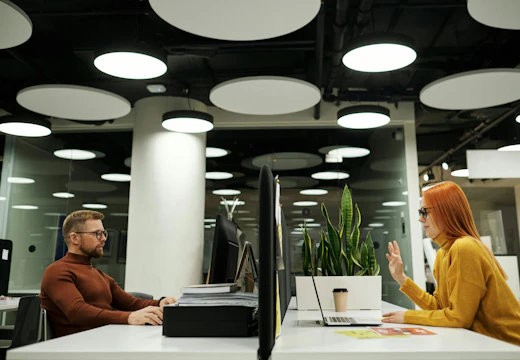
Another new study by Nasiri and colleagues (2026) found that when working in areas with moderate amounts of enclosure, people are most curious. But what is moderate? Moderate is midway between a completely open workplace and one in which all work in cell offices—so in spaces with moderate enclosure there are a few walls/screens dividing up views across a space. Nasiri and team report not only that curiosity is greatest with middling levels of enclosure, but also that moods are improved.
The new research builds on earlier research. Pisciotta (2020) studied how design can support curiosity in academic libraries, tying it to unusual (but pleasantly perceived) elements in spaces. Wilson (2025) also studied on how design can support creativity, sharing that ‘spaces cultivate curiosity by offering unexpected, contrasting, and multisensory experiences that capture and focus attention. Spaces, objects, and materials that are surprising, novel, or unexpected trigger our curiosity and sensemaking.’
Sense of awe
Curiosity is often associated with awe, which does all sorts of good things for us, including making it more likely we’ll think creatively and be healthier and in a good mood Keltner (2023).
Feeling awed is also tied to lower stress levels (Bai et al, 2021), more efficient processing of cognitive information (Shiota, Keltner, and Mossman, 2007), greater creativity (Yeung, Tschetter, and Shiota, 2011), more likelihood of acting to benefit others (Jiang and Sidikides, 2022), as well as being curious (Anderson and Keltner, 2014; Sawada and Nomura, 2024), for example.
Awe can be induced by design elements in a variety of ways, for example, via size, use of unusual materials, or exquisite workmanship (Shiota, Keltner, and Mossman, 2007; Joye and Verpooten, 2013). People can experience awe multiple times in the same location/circumstances (Meagher 2018).
The overall message from research is that curiosity is good for us and our brains, and design can increase the likelihood that some part of our world intrigues us.
Read more of the latest research insights from Sally Augustin in Research Roundup, her regular column in the Innovation Zone for WORKTECH Academy members and partners here.
Research sources
Craig Anderson and Dacher Keltner. 2014. ‘Puzzle Me This: The Emotion of Awe Promotes Curious Engagement with Difficult Puzzles.’ 15th Annual Meeting of the Society for Personality and Social Psychology, Austin Texas, February 13-15, Abstracts; 298.
Yang Bai, Joseph Ocampo, Genina Jin, Serena Chen, Veronica Benet-Martinez, Maria Monroy, Craig Anderson, and Dacher Keltner. 2021. ‘Awe, Daily Stress, and Elevated Life Satisfaction.’ Journal of Personality and Social Psychology, vol. 120, no. 4, pp. 837-860.
Davide Clemente, Claudia Russo, Luciano Romano, Annalisa Theodorou, Elena Rinallo, Camilla Romano, Stepan Vesely, and Angelo Panno. 2026. ‘Nature in Virtual Reality and Curiosity: The Mediating Role of Restorativeness.’ Technology, Mind, and Behavior, in press.
- Jiang and C. Sidikides. 2022. ‘Awe Motivates Authentic-Self Pursuit Via Self-Transcendence: Implications for Prosociality.’ Journal of Personality and Social Psychology, vol. 123, no. 3, pp. 576-596.
Yannick Joye and Jan Verpooten. 2013. ‘An Exploration of the Functions of Religious Monumental Architecture from a Darwinian Perspective.’ Review of General Psychology, vol. 17, no. 1, pp. 53-68.
Dacher Keltner. 2023. Awe: The New Science of Everyday Wonder and How It Can Transform Your Life. Penguin Press; New York.
Benjamin Meagher. 2018. ‘Deciphering the Religious Orientation of a Sacred Space: Disparate Impressions of Worship Settings by Congregants and External Observers.’ Journal of Environmental Psychology, vol. 55, pp. 70-80.
Simin Nasiri, Sonit Bafna, and Thackery Brown. 2026. ‘The Architecture of Curiosity: How Spatial Configuration Influences Affect, Exploration, and Memory.’ Neuropsychologia, vol. 229, 109504.
- Sawada and M. Nomura. 2024. ‘Awe Increases Stimulus-Specific Curiosity.’ Journal of Cognitive Psychology, vol. 36, no. 6, pp. 769-774.
Henry Pisciotta. 2020. ‘Mind the Gap: Embodied Cognition, Curiosity, and Recent Designs for Academic Libraries.’ 108th ACSA Annual Meeting, pp. 925-932.
- Shiota, D. Keltner, and A. Mossman. 2007. ‘The Nature of Awe: Elicitors, Appraisals, and Effects on Self-Concept.’ Cognition and Emotion, vol. 21, pp. 944-963.
Daniel Wilson. 2025. ‘Places of Curiosity.’ Learning-Outside In.
Wan Yeung, Ashley Tschetter, Michelle Shiota. 2011. ‘Differential Effects of Distinct Positive Emotions on Creativity.’ APA Division 8, Society for Personality and Social Psychology Conference, January 27-29