The self-adapting workplace: from data-rich to insight-ready offices
Can a workplace truly be self-adapting? A new report by VergeSense and WORKTECH Academy explores what it takes for offices anticipate change rather than just record it
Most organisations today are overloaded with workplace data. From occupancy sensors and desk-booking systems to badge swipes and environmental monitors, almost every facet of the workplace is being measured and monitored. Yet more often than not, this data gets stuck in a passive cycle where it is collected but not acted upon.
That gap is the starting point for a new report, The Self-Adapting Workplace: How Predictive Intelligence Is Shifting the Office into an Adaptive System, published by VergeSense in collaboration with WORKTECH Academy. Its central argument is that organisations have become ‘data rich, but insight poor’, which means that organisations are often collecting more than enough information to guide decisions, but lacking the strategic muscle to convert it into foresight.
Turning data into insight
The report sets of the rationale for why organisations need to start acting on the data they have to remain resilient in the future. Corporate real estate is navigating a period of sustained turbulence around economic volatility, shifting workforce composition, evolving hybrid policies, and the accelerating footprint of AI on how and where work happens. Under those conditions, planning from historical data alone has limitations. What an office needed in 2023 bears little resemblance to what it needs in 2026 – and by 2028, the report argues, the picture will have shifted again.
‘Workplace analytics has historically focused on looking backwards at data, and that’s still extremely relevant and useful,’ says Brad Golden, Workplace Insights & Advisory Lead at VergeSense. ‘But there’s also this new frontier where we can begin to anticipate and predict what might happen in the future, using historical data as a reference point.’
Office footprints sit among the largest fixed costs on any organisation’s balance sheet, and decisions about how much space to hold, where, and how it’s configured carry consequences that play out over years. Getting it wrong is expensive, and the margin for error is narrowing.
A framework for the journey
The report charts the appetite for change. Investment in analytics platforms is rising, interest in AI-enabled tools is growing, and workplace leaders increasingly want to move beyond retrospective reporting. What’s missing, the report finds, is a shared framework for turning that intelligence into confident, forward-looking decisions about future space needs.
Drawing on expert interviews with VergeSense leadership and a review of industry and academic literature, The Self-Adapting Workplace sets out to close that gap. It maps where organisations currently sit on the path from data collection to predictive intelligence and explores what moving further along that path actually requires.
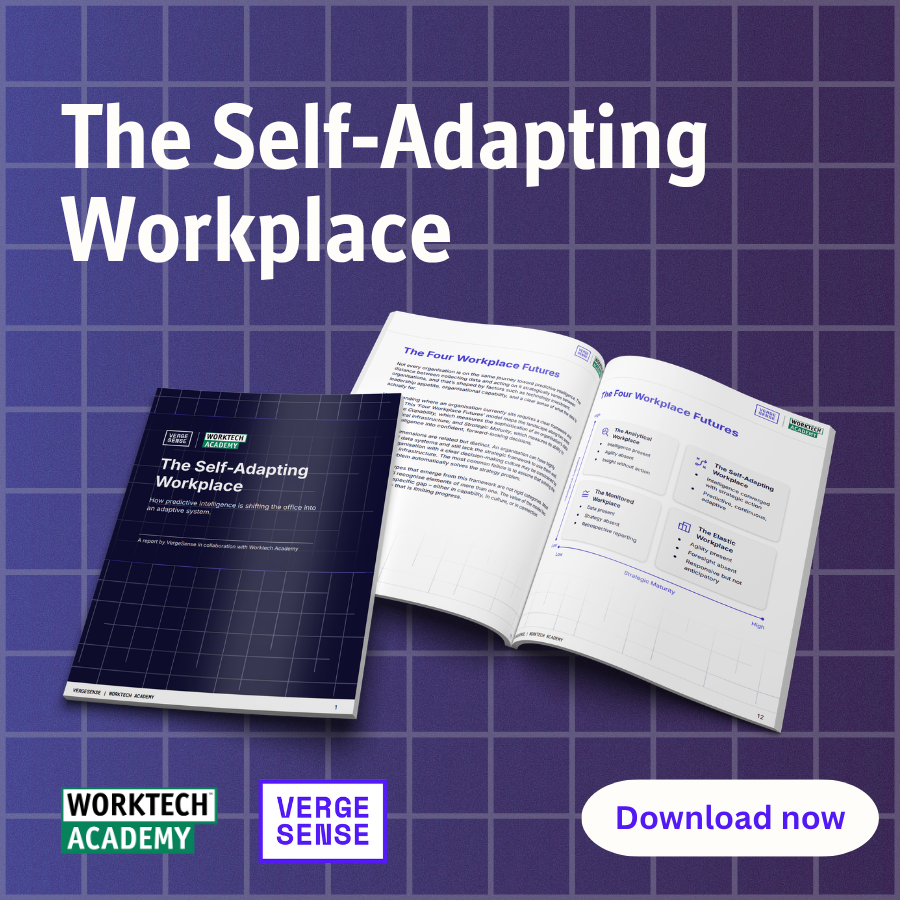
To help organisations locate themselves, the report introduces a ‘Four Workplace Futures’ model, plotted across two axes:
- Intelligence Capability: the sophistication of an organisation’s data and analytical infrastructure
- Strategic Maturity: its ability to convert that intelligence into confident, forward-looking decisions
The two are related but distinct, the report stresses. An organisation can run highly sophisticated data systems and still lack the strategic framework to use them well. Equally, a business with a strong decision-making culture can be held back by immature data infrastructure. The most common mistake is assuming that solving the technology problem automatically solves the strategy problem.
The four archetypes that emerge aren’t meant to be rigid boxes – most organisations will recognise traces of more than one. The value of the model lies in pinpointing exactly where the gap sits and using that diagnosis to chart a path toward a genuinely self-adapting workplace.
Read the full report here, The Self-Adapting Workplace: How Predictive Intelligence Is Shifting the Office into an Adaptive System.