The workplace innovations that defined ISE 2026
ISE 2026 signalled a new wave of AI-enabled workplace technologies that point to a future where physical and digital environments are increasingly interoperable, intelligent and measurable
After more than five years spent trying to stabilise hybrid work patterns, organisations are starting to turn their attention to how well people can collaborate, connect and build authentic relationships across distributed teams. It is against this backdrop that the Integrated Systems Europe (ISE) conference arrives each year, bringing innovations that nudge physical and digital worlds closer together. This year was no exception as new technologies, armed with shiny AI-integrated upgrades, appeared on the expo floor.
From the 3rd – 6th February, more than 1,700 exhibitors flocked to Fira De Barcelona Gran Via to showcase their latest AV technologies. The WORKTECH Academy team was on the ground navigating the 82,000sqm of exhibitor floor space to scout the latest innovations in the world of work.
There was a clear theme around reducing friction between systems and enhancing interoperability – stand out examples included Appspace’s showcase of its wide-ranging partners and open API platform and Google and Microsoft who have joined forces to allow seamless integration without third-part bridges.
Here are the top workplace innovations we’ve pulled out from our time on the floor:
Microsoft Places: connected workplace intelligence
Microsoft Places is a new AI-powered connected workplace platform that helps organisations understand, coordinate and optimise how people use the workplace. The tool combines scheduling, utilisation insights, desk and room bookings, and employee location signals into one platform to help plan where and when people work most effectively.
Places aggregates data from Microsoft 365 tools like Teams and Outlook to help coordinate when people come together and why, not just where they site. It moves beyond booking into predictive workplace intelligence and uses AI to suggest optimal times for in-office attendance and allows workplace teams to manage workspace capacity based on real-time data.
HP Dimension on Google Beam: the emergence of digital copresence
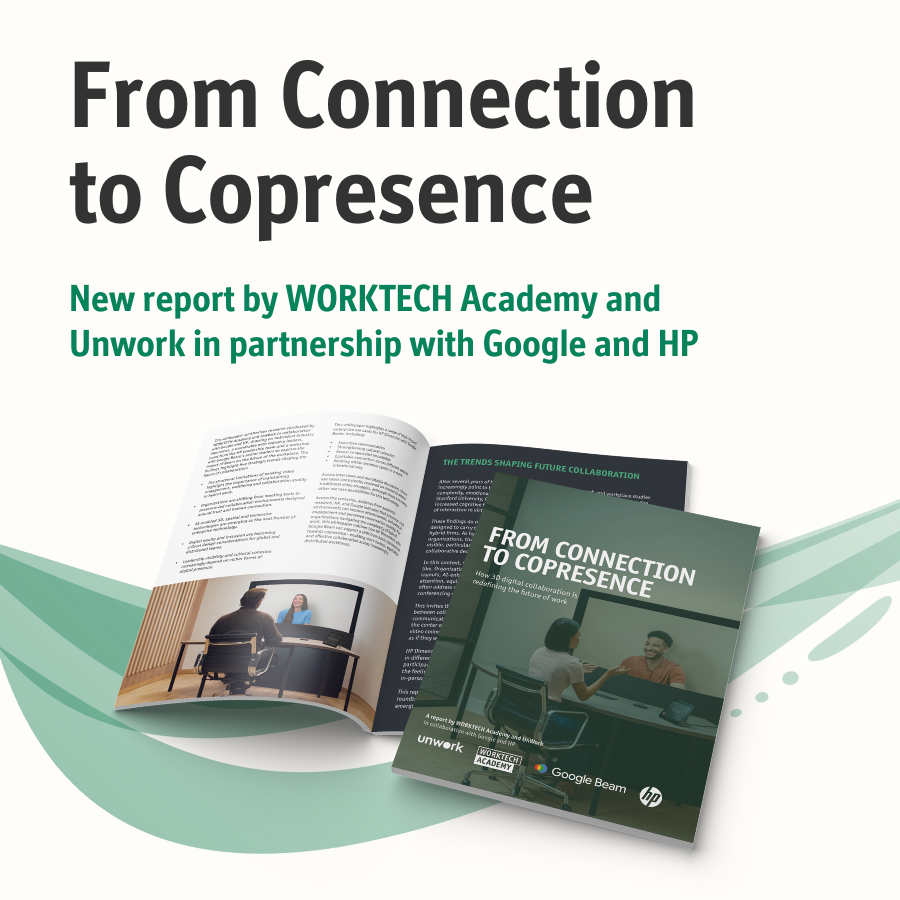
HP Dimension on Google Beam is an AI-powered true-to-life video communication platform. The collaboration between Google Beam (platform) and HP (hardware) aims to make remote collaboration feel much closer to in-person interaction, without headsets or special glasses.
The Beam platform leverages next-generation audio and visual technology to create 3D visuals that maintain depth, eye contact and natural gestures which improves non-verbal communication cues in meetings.
This technology comes at a time when workforce engagement is at an all-time low since the pandemic, according to Gallup. Research points to leaders struggling to engage with distributed teams and an increase of loneliness across the workforce. In this context, Beam is positioned to enhance traditional video conferencing to support authentic connection across hybrid organisations.

HP Dimension on Google Beam. Source: Google Beam
Cisco: intelligent meeting systems
Cisco’s collaboration portfolio is evolving into a data-rich meeting room ecosystem. It’s AI-powered meeting experiences across Webex devices aim to improve visual framing, audio clarity and digital equity.
At ISE, Cisco demoed a new concept called ‘cinematic meetings’ powered by RoomOS which combine multi-camera setups, intelligent microphones and ultra-wide displays to create more immersive in-room and hybrid experiences. Alongside Webex, Cisco devices also support Microsoft Teams, Zoom and Google Meet environments.
Cisco’s Workspace Designer software and analytics via Control Hub enable visual planning, management, and measurement of collaboration environments. This effectively turns meeting rooms into powerful data-led insights.

Cisco’s Cinematic Meetings powered by RoomOS. Source: Cisco
Noro Portal: Life-sized, immersive video conferencing
Noro demonstrated life-size, full-body spatial video portals that connect two remote spaces so participants appear at human scale with eye-contact alignment, creating a ‘same-room’ experience without headsets or avatars. The technology won ‘Best of Show’ at ISE 2026.
The system aims to create continuous live links between offices, enabling real-time collaboration, workshops, or informal interactions as if teams were co-located.
At the ISE Innovation Park pitching stage, Noro presented ‘Shared Studios’, positioning the technology as a new model for persistent cross-office collaboration environments rather than occasional video meetings.
Shure: AI-enhanced collaboration and analytics
Shure introduced the ‘IntelliMix’ Bar Pro, an all-in-one video bar designed for AI-enabled hybrid meetings. Its patent-pending camera architecture and IntelliMix View™ AI framing accurately capture non-verbal cues, using four 4K cameras to intelligently frame and highlight participants across the room.
Onboard IntelliMix audio processing isolates voices and suppresses background noise, improving speech clarity and supporting high-quality transcription for AI tools such as Microsoft Copilot in Teams. Built on the Microsoft Device Ecosystem Platform (MDEP), the IntelliMix Bar Pro also delivers enterprise-grade security, scalability and long-term manageability which helps to position it as a future-ready foundation for AI-powered collaboration.
Philips Professional Displays: AI-ready displays
Philips Professional Displays showcased AI-ready signage models with capabilities for smarter content delivery, real-time audience engagement and predictive maintenance. This technology signals that AI-ready displays are becoming nodes of real-time analytics and engagement that can tie into building operations and workplace experience platforms.

Philips Signage 5000 Series. Source: Philips
AI cameras redefining hybrid meeting equity
AI-driven meeting cameras from Neat, Huddly and Logitech demonstrated how hybrid meeting equity is increasingly being solved at an infrastructure level. Capabilities such as intelligent framing, speaker attribution and multi-stream views reduce the inequity gap between in-room and remote participants.
Teams-Meet interoperability
ISE highlighted growing interoperability between Microsoft Teams Rooms and Google Meet hardware, allowing seamless joining across platforms without third-party bridges. As organisations increasingly share space with partners, clients or other tenants, platform-agnostic meeting rooms are becoming essential infrastructure, particularly in multi-tenant and shared-amenity buildings.

Team-Meet interoperability. Source: Microsoft#
While hundreds of technologies were on display at ISE 2026, a small number of clear workplace signals stood out. Across the four-day event, it became evident that AI is no longer a novelty, but an embedded layer of intelligence underpinning workplace AV systems. From data-driven orchestration and human-centred digital collaboration to interoperability and immersive experiences, the workplace is entering an era where the boundary between physical and digital is increasingly blurred, and where major technology players are learning to work together to deliver more seamless, frictionless experiences.