Design for mingling: six recurring modes of social interaction
New research from a Dutch design team sheds light on the different ways we connect with each other in public space. How can neuroscience inform workspace strategies for human connection?
Even when we have access to countless numbers of AI agents, we will still need to spend time with other human beings. Interacting with others remains one of the core psychological drivers that determine wellbeing and performance – and neuroscience research has an extensive history of studying the best ways for people to mingle.
A new study on social interaction in public space from the Delft University of Technology in the Netherlands (Mohammadi et al, 2026) sheds further light on the subject by exploring six recurring modes of public interaction that environmental design should support.
In this new research, ‘co-presence’ is described as the mutually perceptible sharing of a public setting with calibrated distance and minimal acknowledgment; ‘co-attention’ is orienting toward a common stimulus while weakly engaged with one another; ‘co-exchange’ is a reciprocal interaction in which one participant’s act normatively calls for uptake by another; and ‘co-action’ is sustained joint action organised through shared intentionality and mutual adjustment around a common practical activity
‘Assembly’ involves large-scale gatherings enacting collective presence through sustained coordination, while ‘withdrawal’ signifies maintained public presence under reduced engagement obligations. These are all states of interaction that require careful design consideration.
Mingling methods
How can design best support social interactions? Prior research suggests, for instance, that designers should co-locate people to boost desired, serendipitous interactions (Waber, 2013) as well as providing individual and team-level territories (Appel-Meulenbroek, Groenen, and Janssen, 2011; Byron and Laurence, 2015; Kim, Candido, Thomas and de Dear, 2016).
Interior spaces should give at least some users seats that offer prospect and refuge (Heerwagen and Gregory, 2008) and feature lots of curving lines (but not exclusively curving lines) in two- and three-dimensions (Dazkir and Read, 2012). Designers should include ‘extra’ places to sit as social interaction is enhanced when only 70% of available seats are occupied (Gehl, 2010) – and make sure areas smell like lavender as this scent has been tied to higher trust levels (Sellaro et al, 2015).
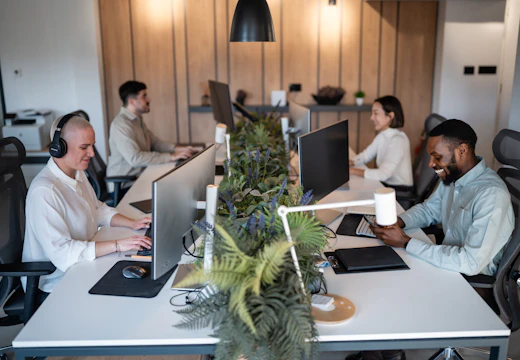
Including one or two green leafy plants in each major sightline supports social interaction (Joye, Willems, Brengman, and Wolf, 2010), as does featuring warm colours, but not red (Elliot, Maier, Moller, Friedman, and Meinhardt, 2007; Choi, Chang, Lee, and Chang, 2016). When someone must participate remotely, make sure their head is the same size as those present onsite and positioned about the same height above the floor (Bailenson et al, 2021).
A bonus from making people feel linked to each other: Weinstein, Legate and Przyylski (2012) learned that when people feel more connected to others, they perceive that the space they’re in is more attractive.
Read more of the latest research insights from Sally Augustin in Research Roundup, her regular column in the Innovation Zone for WORKTECH Academy members and partners here.
Research sources
Rianne Appel-Meulenbroek, Peter Groenen, and Ingrid Janssen. 2011. ‘An End-User’s Perspective on Activity-Based Office Concepts.’ Journal of Corporate Real Estate, vol. 13, no. 2, pp.122-135.
Bailenson. 2021. ‘Nonverbal Overload: A Theoretical Argument for the Causes of Zoom Fatigue.’ Technology, Mind, and Behavior, vol. 2, no. 1.
Kris Byron and Gregory Laurence. 2015. ‘Diplomas, Photos, and Tchotchkes as Symbolic Self-Representations: Understanding Employees’ Individual Use of Symbols.’ Academy of Management Journal, vol. 58, no. 1, pp. 298-323.
Jungsil Choi, Young Chang, Kiliae Lee, and Jae Chang. 2016. ‘The Effect of Perceived Warmth on Positive Judgment.’ Journal of Consumer Marketing, vol. 33, no. 4, pp. 235-244.
Sibel Dazkir and Marilyn Read. 2012. ‘Furniture Forms and Their Influence on Our Emotional Responses Toward Interior Environments.’ Environment and Behavior, vol. 44, no. 5, pp. 722-732.
Andrew Elliot, Markus Maier, Arlen Moller, Ron Friedman, and Jorg Meinhardt. 2007. ‘Color and Psychological Functioning: The Effect of Red on Performance Attainment.’ Journal of Experimental Psychology; General, vol. 136, no. 1, pp. 154-168.
Jan Gehl. 2010. Cities for People. Washington, DC: Island Press.
Judith Heerwagen and Bert Gregory. 2008. ‘Biophilia and Sensory Aesthetics.’ In Stephen Kellert, Judith Heerwagen, and Martin Mador (eds.) Biophilic Design, John Wiley and Sons: Hoboken, NJ, pp. 227-241.
Joye, K. Willems, M. Brengman, and K. Wolf. 2010. ‘The Effects of Urban Retail Greenery on Consumer Experience: Reviewing the Evidence from a Restorative Perspective.’ Urban Forestry and Urban Greening, vol. 9, pp. 57-64.
Jungsoo Kim, Christina Candido, Leena Thomas, and Richard de Dear. 2016. ‘Desk Ownership in the Workplace: The Effect of Non-Territorial Working on Employee Workplace Satisfaction, Perceived Productivity and Health.’ Building and Environment, vol. 103, pp. 203-214.
Mohammad Mohammadi, Erwin Heurkens, and Mohsen Mohammadi. 2026. ‘Social Interaction in Public Space: A Meta-Narrative Review.’ Journal of Environmental Psychology, vol. 112, 103080.
Roberta Sellaro, Wilc van Dijk, Claudia Paccani, Bernhard Hommel, and Lorenza Colzato. 2015. ‘A Question of Scent: Lavender Aroma Promotes Interpersonal Trust.’ Frontiers in Psychology, vol. 5, 1486.
Ben Waber. 2013. People Analytics: How Social Sensing Technology Will Transform Business and What It Tells Us About the Future of Work. FT Press: Upper Saddle River, NJ.
Netta Weinstein, Nicole Legate, and Andrew Przybylski. 2012. ‘Beauty Is In the Eye of the Psychologically Fulfilled: How Need Satisfying Experiences Shape Aesthetic Perceptions of Spaces.’ Motivation and Emotion, vol. 37, no. 2, pp. 245-260.