New research charts the significance of in-between spaces
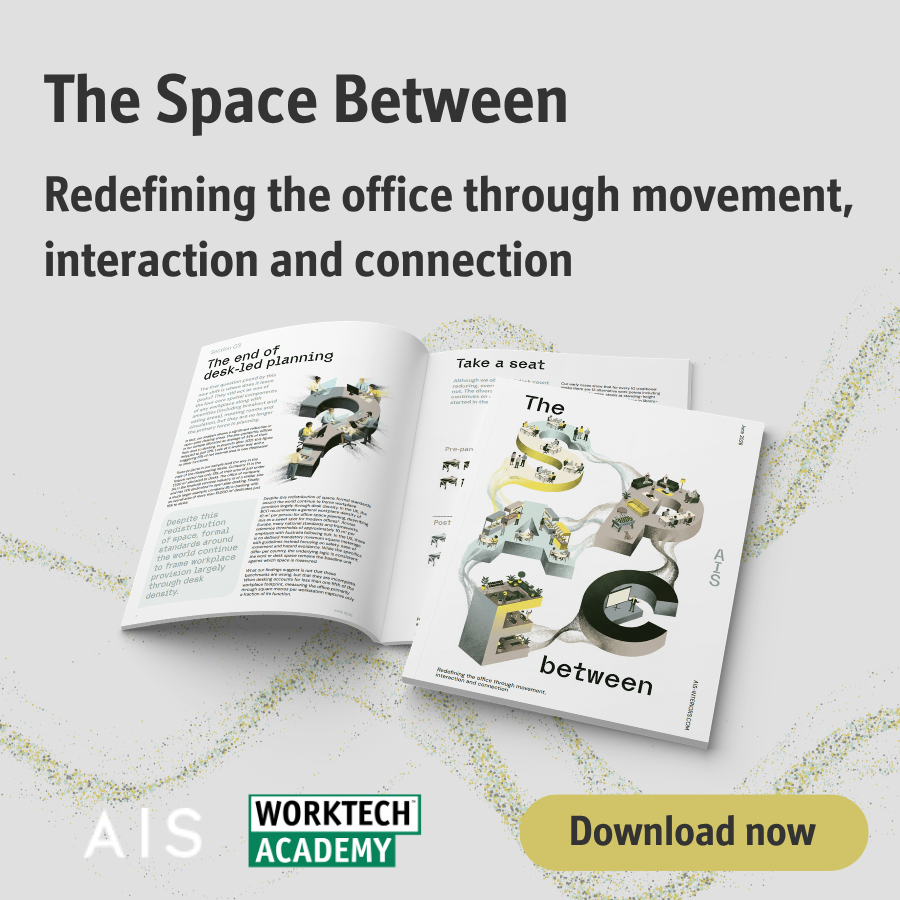
Research by design firm AIS, in collaboration with WORKTECH Academy, explores the opportunities to intentionally design the space between desks
The desk has long been the unit of measurement in office design. Headcount determined floorplates, efficiency was measured in workstations per square metre, and the space between those workstations was largely incidental – a residue of layout rather than a deliberate act of design.
But as the office diversifies into a richer variety of settings, there is a structural shift emerging in those in-between space. A new research report from workplace interiors company AIS, developed in collaboration with UCL professor Dr Kerstin Sailer and WORKTECH Academy, identifies this shift as a critical underexplored design opportunity for the workplace.
Drawing on the spatial analysis of 18 financial services offices, split evenly before and after the pandemic, the report identifies a structural reorganisation of office space. Findings show that open-plan desking has fallen from 34% of floor area pre-pandemic to just 19% today. At the same time, collaborative settings now account for close to half of the typical workplace footprint. The office is being redesigned around an entirely different set of priorities.
Movement as a strategic resource
As offices move away from rows of open-plan desking towards a greater variety of collaborative, focused and social settings, the connective tissue between those settings – the corridors, transition zones and circulation routes – expands in both scale and frequency. Every new setting type generates new flows. And those flows, if left undesigned, are simply paths.
The research finds that corridor space has increased from 24% to 30% across the workplans analysed. This additional space can be leveraged as a strategic resource to curate moments for chance encounters, respite, and informal exchange across the workplace.
The shift towards more corridor space is also visible at the scale of individual desking clusters. Neighbourhoods have become smaller and more intimate since the pandemic, with average sizes reducing significantly across the sample. The research suggests this is not incidental but intentional, reflecting a larger move towards workplaces organised around the quality of experience rather than the quantity of seats.
The report also examines how organisations are rethinking what return on investment means for workspace, and what all of this requires from designers, real estate professionals and the executive teams who commission office space.
Read the full The Space Between report here.