The complex cultural mix that influences our cognitive state
What mindset should designers be aiming to support? New research suggests that how we want to feel in the workplace is a stronger cultural indicator than how we currently feel
The ways that sensory and other experiences in our physical and virtual worlds influence our mood and cognitive state is something that gets discussed often. But the mindset that designers should shoot for in any situation is specifically mentioned far less often—this column aims to rectify that. It is important to say at the outset that culture can influence preferred mindset in nearly any situation.
A recent study led by Jeanne Tsai (2025) used data collected over two decades from more than 31,000 people worldwide to explore the question: what affective states do people ideally want to feel and why? Via a meta-analysis published in the Psychological Bulletin, Tsai and colleagues determined that people’s ‘ideal affect’ (how they want to feel) differs significantly across cultures and is a stronger cultural indicator than ‘actual affect’ (how they currently feel). Also, Europeans and Americans consistently value high-arousal positive states more than East Asian groups.
Tsai’s research acknowledges that many prior studies have shown that how people ideally want to feel—above and beyond how they actually feel—matters individually and interpersonally, and that these processes have important implications for a variety of real-world settings, including in offices, hospitals and schools.
High-arousal states
Jeanne Tsai’s earlier work on this topic also indicated that different national cultures have different preferred moods (2007); this has ramifications for the design of cafeterias and break spaces, for example. Tsai’s investigation of the mood that people of various cultures favour feeling found that Americans preferred ‘high-arousal positive affective states’ (e.g. excitement, enthusiasm)’, while East Asian cultures preferred ‘low-arousal positive affective states (e.g. calm, peacefulness).’
Within the differences that can be tied to culture, the desired mindset in workplaces is generally relaxed but attentive (Gifford, 2014); this is a relatively calm state in which people are activated enough to focus on a solo or team task at hand. Generating this mood, there is value in adopting colour palettes that are relatively less saturated and lighter than elsewhere, for example, and avoiding the colour red as it signals ‘alarm’ and pushes our activation level beyond the capacity to do good work.
Appel-Meulenbroek, Le Blanc, and de Kort (2020) link how activating, stimulating or energising it is to be in a designed space with the level of employee performance. The research team reports that that according to person-environment fit theory, interaction between employee and environment is optimal when the environment supports the most important needs of users. Suboptimal fit results in stress.
Focus and stimulation
Fifty years ago Wohlwill (1966) reported on the fact that cognitive tasks that require more focus and mental effort are best done in relatively less stimulating physical environments but if a cognitive activity doesn’t require much concentration or mental effort, perhaps because we’ve done it many times in the past, we perform well in a relatively more stimulating environment.
Research consistently shows that we run down the stocks of energy in our mental batteries as we do work that requires us to concentrate, particularly if we encounter sensory and emotional distractions and stressors; but our brains have rechargeable ‘batteries’. If we’re distracted or stressed, some of our mental processing power is unavailable to work on whatever we’re trying to accomplish whether we’re working alone or with others. Csikszentmihalyi (1996) reports that ‘attention is a limited resource’ and distractions and stressors guzzle it up as we’re trying to focus.
We are a sociable species, so being around other people revs us up (Cain, 2012); any situation in which we can see others should be relatively relaxing design-wise, with less stimulating surface and light colours, for instance.
Views of others
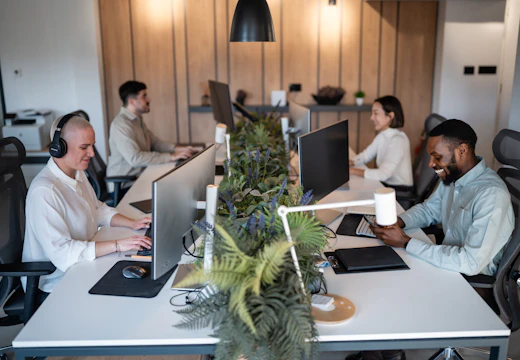
Researchers have learned a lot about how views of others influence us. Sailer and colleagues (2021) analysed data collected in open-plan offices and they report that, ‘Results of a staff survey in the UK headquarters of a global technology company . . . [indicate] that staff are less likely to rate their workplace environment favorably when they have higher numbers of desks within their own field of vision; and when they are facing away from the room with a relatively larger area behind their back compared to the area surrounding them.’
In contrast, having fewer people in sight and feeling more in control of the environment by facing the room resulted in significantly higher odds for positive ratings of focused work and perceived productivity. The study concluded that ‘designing smaller and more intimate areas might be advisable as an immediate workplace design choice.’
Similarly, Brunia, de Been, and van der Voordt (2016) compared data gathered from people satisfied and dissatisfied with shared activity-based workplaces. The study determined that ‘Regarding the physical environment, most critical seems to be a well-thought-out spatial support of both communication and concentration. Open spaces should be alternated with enclosed rooms that are dedicated to concentration work or telephone calls and provide some privacy. Sufficient acoustic measures are needed to avoid aural distraction.’
Recovery from stress
Roskams, McNeely, Weziak-Bialowolska, and Bialowski (2021) linked design and cognitive performance via mental state, mood and stress: ‘Certain features of the workplace environment are effective in promoting recovery from stress. In particular… when nature is brought into the office environment, most typically through interior plants, benefits include not only lower subjective stress but also higher health and job satisfaction, improved information processing and management, greater attention capacity, and higher self-rated productivity.’
It is clear from research that design can help fine-tune mental balance, with implications for performance and satisfaction, and that culture plays a key role in shaping cognitive states.
Read more of the latest research insights from Sally Augustin in Research Roundup, her regular column in the Innovation Zone for WORKTECH Academy members and partners here.
Research sources
Rianne Appel-Meulenbroek, Pascale Le Blanc, and Yvonne de Kort. 2020. ‘Person-Environment Fit: Optimizing the Physical Work Environment.’ In Oluremi Ayoko and Neal Ashkanasy (eds.) Organizational Behaviour and the Physical Environment. Routledge; New York, pp. 251-267.
Sandra Brunia, Iris de Been, and Theo van der Voordt. 2016. ‘Accommodating New Ways of Working: Lessons from Best Practices and Worst Cases.’ Journal of Corporate Real Estate, vol. 18, no. 1, pp. 30-47.
Susan Cain. 2012. Quiet: The Power of Introverts in a World That Can’t Stop Talking. Crown Publishers: New York.
Mihaly Csikszentmihalyi. 1996. Creativity: Flow and the Psychology of Discover and Invention. HarperCollins: New York.
Robert Gifford. 2014. Environmental Psychology, Fifth Edition. Optimal Books: Colville, WA.
Michael Roskams, Eileen McNeely, Dorota Weziak-Bialowolska, and Piotr Bialowski. 2021. ‘Job Demands-Resources Model – Its Applicability to the Workplace Environment and Human Flourishing.’ In Rianne Appel-Meulenbroek and Vitalija Danivska (eds.) A Handbook of Theories on Designing Alignment Between People and the Office Environment. Routledge; London, pp. 27-38.
Kerstin Sailer, Petros Koutsolampros, and Rosica Pachilova. 2021. ‘Differential Perceptions of Teamwork, Focused Work and Perceived Productivity as an Effect of Desk Characteristics Within a Workplace Layout.’ PLoS ONE, vol. 16, no. 4, e0250058.
Jeanne Tsai. 2007. ‘Ideal Affect: Cultural Causes and Behavioral Consequences.’ Perspectives on Psychological Science, vol. 2, no. 3, pp. 242–259.
Jeanne Tsai and many others. 2025. ‘A Meta-Analytic Review of Cultural Variation in Affect Valuation.’ Psychological Bulletin, vol. 151, no. 12, pp. 1486-1524.
- Wohlwill. 1966. ‘The Physical Environment: A Problem for a Psychology of Stimulation.’ §§§Journal of Social Issues, vol. 22, no. 4, pp. 29-30.