Why real estate deals give a false picture of progress on hybrid work
Don’t be fooled by brighter news in office leasing markets. While companies are beginning to get to grips with their spatial footprint in the hybrid era, solving the cultural issues will take longer
It has become an article of faith in the workplace industry that rising demand for office space must be a sure sign that the problems of hybrid work are being fixed.
The thinking goes that a healthier real estate market indicates that the large employers are putting the right strategies in place to move forward and that many of the uncertainties around new work practices are being brought under control.
There have been plenty of signals of this type in recent weeks, most notably at Canary Wharf in London – this was once the poster child for the death of the financial district but is now enjoying an impressive comeback with new tenants and new life.
Canary Wharf Group posted profits of £176.3 million for the six months to the end of June 2026, reversing the £33 million loss it had suffered the year before. Its success in attracting new corporate occupiers such as PwC and Visa is being replicated by other real estate players in other cities around the world as demand for flexible, high-quality office space grows.
A mirage of progress
But what if a more buoyant office leasing picture wasn’t confirmation that the nightmarish complexities of hybrid working are behind us? What if it was a mirage that didn’t really solve the problems at all?
The question is worth asking because every optimistic real estate forecast we read can be offset by a gloomy report on how company culture, coordination and morale are struggling as return-to-office policies fail to hit the mark. Gallup set the ball rolling with record figures of employee disengagement earlier in the year and the news hasn’t got much better since. The Flex Index has summed it up well, saying that the office has not fuelled productivity growth in the US this year – remote work and AI have been the main drivers.
What is emerging in the hybrid work debate is a divide between addressing office space itself and addressing what happens on the floor in terms of culture and behaviour. Instead of one overarching approach, there is a splinter into two different types of workplace infrastructure designed to absorb new patterns of hybrid work and support performance.
Two infrastructures
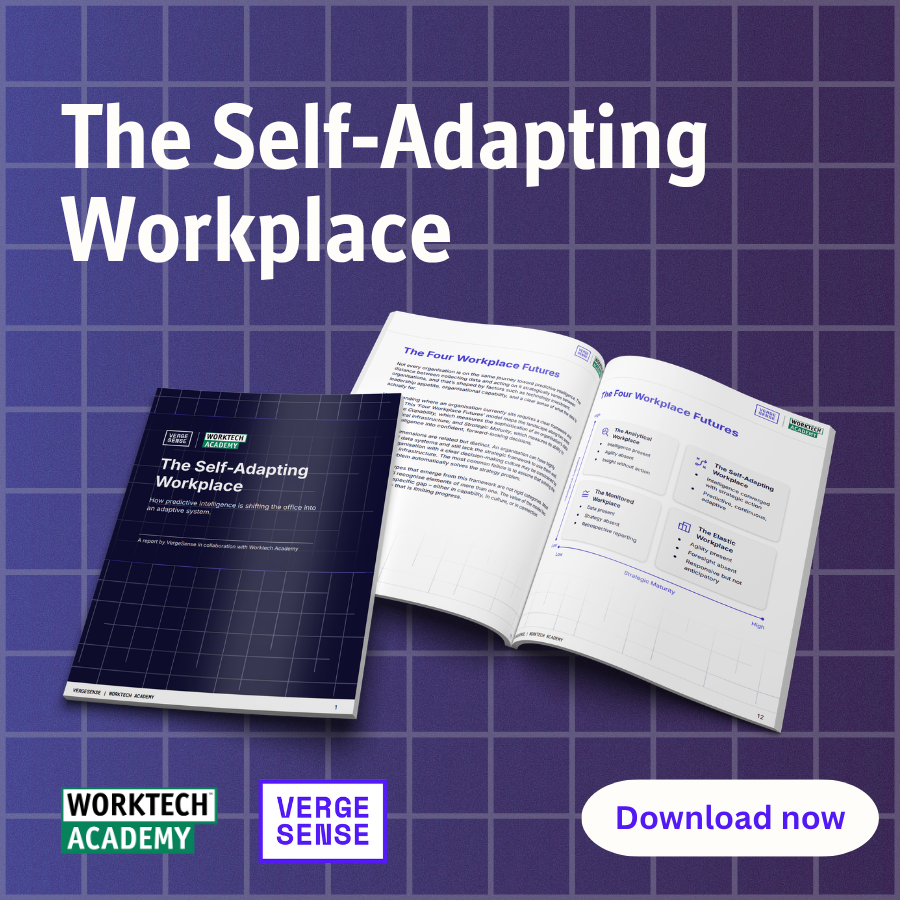
The spatial infrastructure of the office is now very much on the up, supported by the growth of data science and spatial intelligence technologies that make the task of predicting headcounts and ratios easier. A new report from VergeSense with WORKTECH Academy, The Self-Adapting Office, explores this angle.
However, the cultural infrastructure of the office remains stuck in low gear as trust and belonging prove stubbornly hard to build. As James Woudhuysen, Visiting Professor at London South Bank University, told us: ‘The office is currently a place of low productivity, low legitimacy, low morale and too much rhetoric.’
People still openly question whether the office has earned the commute. There is also widespread interest in alternative workplace models, for example the ‘virtual-first’ policy adopted by Dropbox – this uses Dropbox offices for team-building and brainstorming hubs during periodic off-sites or hack weeks rather than for routine daily attendance.
Underlying questions
Until this year, the workplace industry could take comfort in a rising office real estate market as a sign of real progress. Now, tough underlying questions about the effects of hybrid work on culture are surfacing even as the electronic ink is barely dry on signing new leases.
There is plenty to play for in the office market. Not all the news is bad. According to Fortune magazine, seven out of ten Gen Z employees prefer a hybrid work environment with office attendance supporting social connection and early career networking.
Just don’t be fooled by all those promising real estate stats – the people puzzle of hybrid hasn’t been solved yet. Not by a long way.